Recursive Descendant Parser
Syntax Analysis
Ahmad Yoosofan
Compiler course
University of Kashan
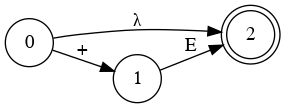
Special State Diagram for Addition
- 2
- 2+3
- 86+54+876+432+32
Grammar
- E → a
- E → a + E
- E → a + E | a
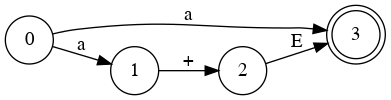
Which edge must we choose from node 0?
Node 1
Node 3
Left Factoring
- E → a + E
- E → a
- E → a B
- B → + E
- B → λ
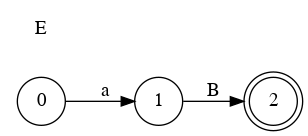
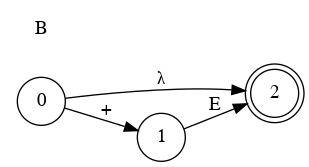
Parser Code for Add
E
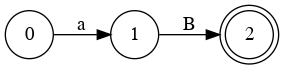
B
1 def E(lex1):
2   t = lex1.getToken()
3   if t.type == 'a':
4     print('a B\t a: ',  t.value, end=',')
5     print('\tB: ',  lex1.s[lex1.end:])
6     return B(lex1)
7   print('Synatx Error: number expected')
8   print('Reminder: ',lex1.s[lex1.begin:])
9   return False
10
11 def B(lex1):
12   t = lex1.getToken()
13   if t.type == '+':
14     print('+E,\tE:', lex1.s[lex1.end:] )
15     return E(lex1)
16   elif t.type == 'EOF': return True
17   print('Error a a:', s[0])
18   return False
19
20 def run(s):
21   lex1 = lexical_number_plus.lexical(s);
22   print(E(lex1))
python3 a.py 12.1  + 35.45 + 2

a B  a:  12.1,  B:  +35.45+2
+E, E: 35.45+2
a B  a:  35.45, B:  +2
+E, E: 2
a B  a:  2.0, B:
True
python3 a.py 12.1 + + 2
12.1 + + 2
a B a: 12.1, B: ++2
+E, E: +2
Synatx Error: number expected
Reminder: +2
FalseParse Tree
1 def E(lex1):
2   t = lex1.getToken()
3   if t.type == 'a':
4     print('a B\t a: ',  t.value, end=',')
5     print('\tB: ',  lex1.s[lex1.end:])
6     return B(lex1)
7   print('Synatx Error: number expected')
8   print('Reminder: ',lex1.s[lex1.begin:])
9   return False
10
11 def B(lex1):
12   t = lex1.getToken()
13   if t.type == '+':
14     print('+E,\tE:', lex1.s[lex1.end:] )
15     return E(lex1)
16   elif t.type == 'EOF': return True
17   print('Error a a:', s[0])
18   return False
19
20 def run(s):
21   lex1 = lexical_number_plus.lexical(s);
22   print(E(lex1))
python3 a.py 12.1  + 35.45 + 2

a B  a:  12.1,  B:  +35.45+2
+E, E: 35.45+2
a B  a:  35.45, B:  +2
+E, E: 2
a B  a:  2.0, B:
True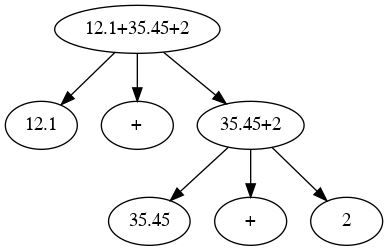
- E[12.1+35.45+2] ⇒
- a[12.1] + E[35.45+2] ⇒
- a[12.1] + a[35.45] + E[2] ⇒
- a[12.1] + a[35.45] + a[2] ⇒
- Left Most Derivation
Doing Addition
1 def E(lex1):
2   t = lex1.getToken()
3   if t.type == 'a':
4     print('a B\t a: ',  t.value, end=',')
5     print('\tB: ',  lex1.s[lex1.end:])
6     return B(lex1)
7   print('Synatx Error: number expected')
8   print('Reminder: ',lex1.s[lex1.begin:])
9   return False
10
11 def B(lex1):
12   t = lex1.getToken()
13   if t.type == '+':
14     print('+E,\tE:', lex1.s[lex1.end:] )
15     return E(lex1)
16   elif t.type == 'EOF': return True
17   print('Error a a:', s[0])
18   return False
19
20 def run(s):
21   lex1 = lexical_number_plus.lexical(s);
22   print(E(lex1))
1 def E(lex1):
2   t = lex1.getToken()
3   if t.type == 'a':
4     print('a B\t a: ',  t.value, end=',')
5     print('\tB: ',  lex1.s[lex1.end:])
6     res = B(lex1)
7     return res[0], t.value + res[1]
8   print('Synatx Error: number expected')
9   print('Reminder: ',lex1.s[lex1.begin:])
10   return False, 0
11
12 def B(lex1):
13   t = lex1.getToken()
14   if t.type == '+':
15     print('+E,\tE:', lex1.s[lex1.end:] )
16     return E(lex1)
17   elif t.type == 'EOF':
18     return True, 0
19   print('Error a a:', s[0])
20   return False, 0
python3 a.py 12.1  + 35.45 + 2

a B  a:  12.1,  B:  +35.45+2
+E, E: 35.45+2
a B  a:  35.45, B:  +2
+E, E: 2
a B  a:  2.0, B:
(True, 49.550000000000004)
python3 a.py 2 +

a B  a:  2.0, B:  +
+E, E:
Synatx Error: number expected
Reminder:
(False, 2.0)
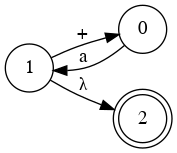
Simplify Diagram
E
B
Combine them
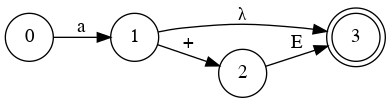
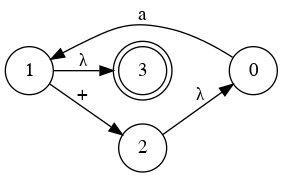
E
Parser Code for add Nonrecursive
E
1 def E(lex1):
2   while True:
3     t = lex1.getToken()
4     if t.type == 'a':
5       print('a: ',  t.value, end=',')
6       print('\t: ', lex1.s[lex1.end:])
7     else:
8       print('Synatx Error: number expected')
9       print('\t', lex1.s[lex1.begin:])
10       break
11     t = lex1.getToken()
12     if t.type != '+':
13       if t.type != 'EOF':
14         print('End of input expected')
15       break
16   if t.type != 'EOF': return False
17   return True
18
19 def run(s):
20   lex1 = lexical_number_plus.lexical(s);
21   print(E(lex1))
input: 16+34+0.30
output:
a:  16.0, :  +34+0.30
a:  34.0, :  +0.30
a:  0.3,  :
True
input: 23+ + 34
output:
a: 23.0, : ++34
Synatx Error: number expected
+34
FalseCalculator Code for add Nonrecursive
E
1 def E(lex1):
2   x = 0.0; state = 0; validity = True;
3   while True:
4     if state == 0:
5       t = lex1.getToken()
6       if t.type == 'a':
7         print('a: ',  t.value, end=',')
8         print('\t: ', lex1.s[lex1.end:])
9         state = 1; x += t.value;
10       else:
11         print('Synatx Error: number expected')
12         print('\t', lex1.s[lex1.begin:]); validity = False; break
13     elif state == 1:
14       t = lex1.getToken()
15       if t.type == '+':  state = 0
16       elif t.type == 'EOF':  state = 2
17       else: print('End of input expected'); validity = False; break;
18     elif state == 2: validity = True; break
19   return validity, x
input: 16+34+0.30
output:
a:  16.0, :  +34+0.30
a:  34.0, :  +0.30
a:  0.3,  :
(True, 50.3)
input: 23+ + 34
output:

a:  23.0, :  ++34
Synatx Error: number expected
   +34
(False, 23.0)
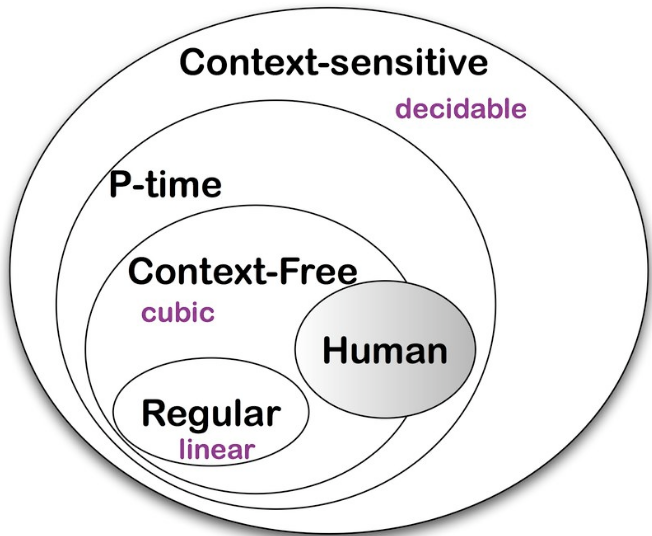
Classes of Languages
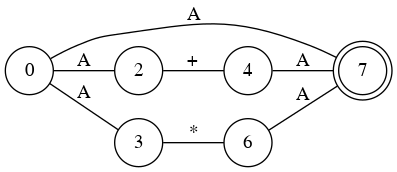
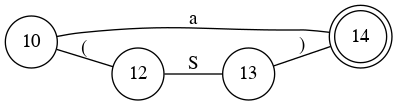
Parse for + * ( ) no priority
Consider the follwing sentences of a langauge:
Write down the Grammar
- 3
- 9 +3
- 9 * 3
- (9 * 3)
- (9 + 3)
- (9 * 4) + 5
- 9 * (4 + 5)
- (9 * (4 + 5)) * 3
- 9 * ((4 + 5) * 3)
- 9 * ((4 + 5) + 3)
- (9 + (4 + 5)) * 3
- S → A + A
- S → A * A
- S → A
- A → (S)
- A → a
Left Factoring
- S → A + A
- S → A * A
- S → A
- A → (S)
- A → a
- S → A B
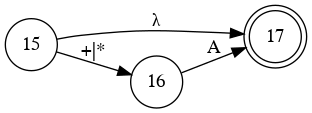
- B → + A | * A | λ
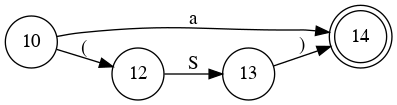
- A → ( S ) | a
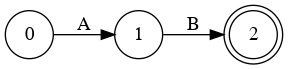
- S
- B
- A
Simplify Diagram
- S
- B
- A
- Combine S and B
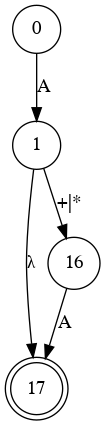
Remove Some Recursion
- S
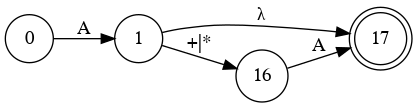
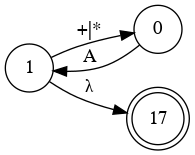
- A
Parser Code
- S
- A
1 def S(lex1):
2   while True:
3     if A(lex1) == False: return False
4     if lex1.ct.type != '+' and lex1.ct.type != '*':
5       break
6     print(lex1.ct.type, ':', lex1.s[lex1.end:])
7     lex1.getToken()
8   if lex1.ct.type == 'EOF' or lex1.ct.type == ')':
9     return True
10   return False
11 def A(lex1):
12   if lex1.ct.type == 'a':
13     print('a: ', lex1.ct.value, end=',')
14     print('\t: ', lex1.s[lex1.end:])
15     lex1.getToken()
16   elif lex1.ct.type == '(':
17     print('(\t: ', lex1.s[lex1.end:])
18     lex1.getToken()
19     if S(lex1) == False: return False
20     if lex1.ct.type != ')' :
21       print('Synatx Error: ) expected')
22       print(lex1.ct.type, '\t', lex1.s[lex1.begin:])
23       return False
24     else: print(')'); lex1.getToken()
25   else:
26     print(' a or ( expected:: ', lex1.ct.type)
27     return False;
28   return True
29 def run(s):
30   lex1 = lexical_number_plus_mul_par.lexical(s);
31   lex1.getToken()
32   if S(lex1) == True:
1 import sys, lexical_number_plus_mul_par
2 def S(lex1):
3   while True:
4     if A(lex1) == False: return False
5     if lex1.ct.type != '+' and lex1.ct.type != '*':
6       break
7     print(lex1.ct.type, ':', lex1.s[lex1.end:])
8     lex1.getToken()
9   if lex1.ct.type == 'EOF' or lex1.ct.type == ')':
10     return True
11   return False
12 def A(lex1):
13   if lex1.ct.type == 'a':
14     print('a: ', lex1.ct.value, end=',')
15     print('\t: ', lex1.s[lex1.end:])
16     lex1.getToken()
17   elif lex1.ct.type == '(':
18     print('(\t: ', lex1.s[lex1.end:])
19     lex1.getToken()
20     if S(lex1) == False: return False
21     if lex1.ct.type != ')' :
22       print('Synatx Error: ) expected')
21       print(lex1.ct.type, '\t', lex1.s[lex1.begin:])
22       return False
23     else: print(')'); lex1.getToken()
24   else:
25     print(' a or ( expected:: ', lex1.ct.type)
26     return False;
27   return True
28 def run(s):
29   lex1 = lexical_number_plus_mul_par.lexical(s);
30   lex1.getToken()
31   if S(lex1) == True:
32     if lex1.ct.type == 'EOF':
33       print(True)
34     else:
35       print('Syntax Error: extra characters')
36       print(lex1.s[lex1.begin:])
37   else:
38     print('Syntax Error at')
39     print(lex1.s[lex1.begin:])
40 if __name__ == "__main__":
41   if len(sys.argv) < 2:
42     print("python3 a.py '12.1  + (35.45 * 2)'")
43     raise SystemExit(f"Usage: {argvs[0]} input expression")
44   s = ''.join(sys.argv[1:])
45   run(s)
Lexical
2 class tokenCls:
3   def __init__(self, type1='EOF',
4       v1='', l1=0, b1=0, e1=0):
5     self.type = type1
6     self.begin = b1
7     self.end = e1
8     self.value = v1
9     self.lineno = l1
10   def __str__(self):
11     return '[type: '+ str(self.type) + \
12      ',\tvalue: ' + str(self.value) + \
13      '\tline: ' + str(self.lineno) + \
14      '\tbegin: ' + str(self.begin) + \
15      '\tend: ' + str(self.end) + ']'
16 class lexical:
17   def __init__(self, s):
18     self.s = s
19     self.begin = 0
20     self.end = 0
21     self.lineno = 0
22     self.length = len(self.s)
23     self.ct = tokenCls(b1=self.begin,
24       e1=self.end)
25   def getToken(self):
26     self.ct = tokenCls(b1=self.begin,
27       e1=self.end)
28     self.begin = self.end
29     while self.end < self.length:
30       a = re.match('[ \t]+', self.s[self.end:])
31       if a is not None:
32         self.end = self.begin = self.end + a.end()
33         if self.end >= self.length:
33           break
34
35       a = re.match('\\d+(\\.\\d+)?',
36         self.s[self.end:])
37       if a is None:
38         self.end += 1
39         operators1 = ['+', '-', '*', '/', '(', ')']
40         if self.s[self.begin:self.end] in operators1:
41           self.ct.type =  self.s[self.begin:self.end]
42           break
43         else:
44           print('Lexical error: ', self.lineno, end=' : ')
45           print(self.begin, ':', self.end, end=' , ')
46           print('Unknown character:', self.s[self.begin:self.end])
47           self.begin += 1
48       else:
49         self.ct.type = 'a'
50         self.ct.value = float(a.group())
51         self.end += a.end()
52         break
53     self.ct.begin = self.begin
54     self.ct.end = self.end
55     self.ct.lineno = self.lineno
56     return self.ct
57 if __name__ == '__main__':
58   #s = input('Enter ') # 12+35+2
59   s = '12+35+2  '
60   s = '  12  +  35 + 2   '
61   s = '  12  +  35 --- 2   '
62   # ~ s = '1.0.'  s = '1.0=23.2+4'
63   s = '12+35+2  '
64   lex1 = lexical(s);
Error Recovery (panic mode)
A Simple Calculator (, ), +, *
- 34
- 34 + 2
- 34 + 45 + 98
- 34 + 45+98 * 4 * 554
- (34 * 2) + 3
- 43 * (54+3)
- 2 + (34)
- (34+3) * 2
- 34+3 * 2 * ((4))
Grammar 1
- S -> S + S
- S -> S * S
- S -> a
- S -> (S)
Incorrect Grammar (Why?)
Grammar 2
- E -> T + E | T
- T -> F * T | F
- F -> (E) | a
Grammar 3
- E -> E + T | T
- T -> T * F | F
- F -> (E) | a
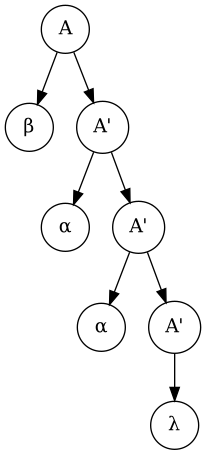
Left Recursion Elimination, A → A α | β, βαα
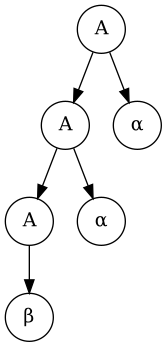
- A ⇒ A α ⇒ A α α ⇒ β α α
- A ⇒ β A′ ⇒ β α A′ ⇒ β α α A′ ⇒ β α α
- A → A α | β
- A → β A'
- A' → α A' | λ
- E → E + T | T
- E → T L
- L → + T L | λ
- T → T * F | F
- T → F M
- M → * F M | λ
- F → (E) | a
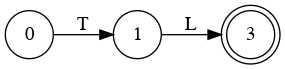
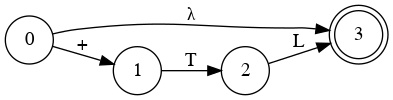
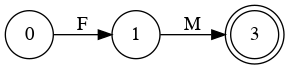
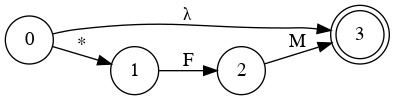
State Diagram(II)
- E → T L
- L → + T L | λ
- T → F M
- M → * F M | λ
- F → (E) | a
E → T L
L → + T L | λ
T → F M
M → * F M | λ
F → (E) | a
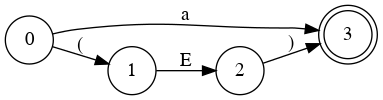
Simplify Diagram(II) - Combine E, L
E → T L
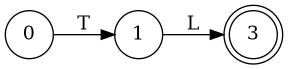
L → + T L | λ
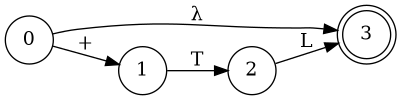
incorrect combination
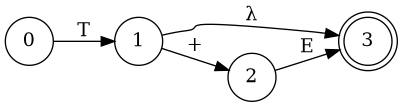
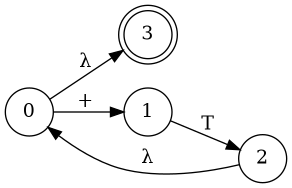
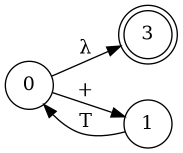
Combine E → T L and simplified chart of L → + T L | λ
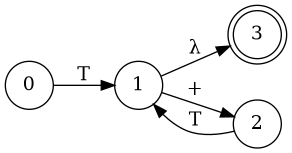
E | 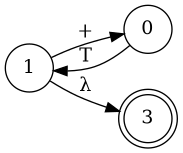 |
- Do the same for the following grammar rules
- T → F M
- M → * F M | λ
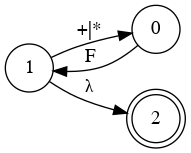
Diagrams of the Second Calculator
E
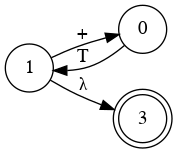
T
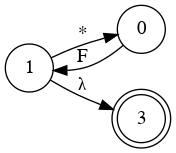
F
Can E and T be combined?
E
- 4 + 3 * 2
- ( 4 + 3 ) * 2
- 4 + ( 3 * 2 )
- 3 * 2 + 4
- 3 * ( 2 + 4 )
- ( 3 * 2 ) + 4
Parser Code for Add and Multiply
E
T
F
1 def S(lex1):
2   lex1.getToken()
3   if E(lex1) == True:
4     if lex1.ct.type == 'EOF':  print(True)
5     else:
6       print('Syntax Error: extra characters at END: ')
7       print(lex1.s[lex1.begin:])
8   else: print('Syntax Error at', lex1.s[lex1.begin:])
9 def E(lex1):
10   while True:
11     if T(lex1) == False: return False
12     if lex1.ct.type != '+': break
13     lex1.getToken()
14   return True
15 def T(lex1):
16   while True:
17     if F(lex1) == False: return False
18     if lex1.ct.type != '*': break
19     lex1.getToken()
20   return True;
21 def F(lex1):
22   if lex1.ct.type == 'a':
23     lex1.getToken()
24   elif lex1.ct.type == '(':
25     lex1.getToken()
26     if E(lex1) == False: return False
27     if lex1.ct.type != ')' : return False
28     lex1.getToken()
29   else: return False
30   return True
Another Language for simple expression + - * / ( )
- 2 + 3 * 4 - 5
- 4 - 5 * 2 / ( 4 - 2 ) + 1
- ( ( 2 * ( 3 - 1) ) / (5 - 3) ) * ( 7 - 8 )
Grammar ?
- E → T + E | T - E | T
- T → F * T | F / T | F
- F → (E) | a
Is there any problem?
- 4 - 3 - 2
- 16 / 4 / 2
It was a incorrect grammar
- E → E + T | E - T | T
- T → T * F | T / F | F
- F → (E) | a
Left Most Derivation
- E ⇒ E + T ⇒
- T + T ⇒
- F + T ⇒
- 16 + T ⇒ 16 + T * F ⇒
- 16 + F * F ⇒
- 16 + 3 * F ⇒
- 16 + 3 * 4
General Form of Direct Left Recursion Elimination
A → A \(α_1\) | A \(α_2\) | \(...\) | A \(α_m\) | \(β_1\) | \(β_2\) | \(...\) | \(β_n\)
- A → A α | β
- A → β A'
- A' → α A' | λ
Convert to
- A → \(β_1\) A' | \(β_2\) A' | \(...\) | \(β_n\) A'
- A' → \(α_1\) A' | \(α_2\) A' | \(...\) | \(α_m\) A' | λ
Calculator Grammar
- E → E + T | E - T | T
- T → T * F | T / F | F
- F → a | (E)
Convert to
- E → T E'
- E' → + T E' | - T E' | λ
- T → F T'
- T' → * F T' | / F T' | λ
- F → a | (E)
Calculator Grammar
- E → T E'
- E' → + T E' | - T E' | λ
- T → F T'
- T' → * F T' | / F T' | λ
- F → a | (E)
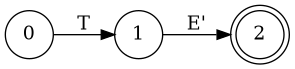
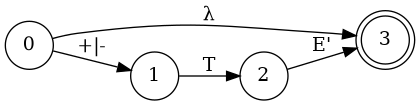
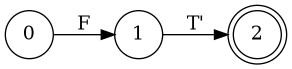
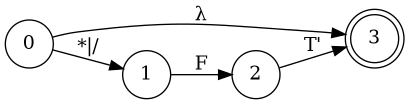
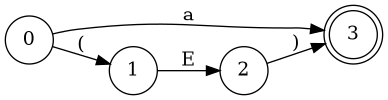
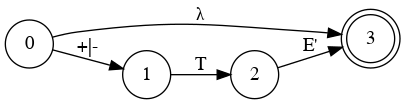
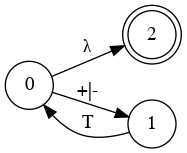
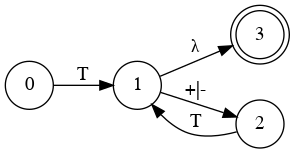
Simplify Diagram(V) - Combine E and E'
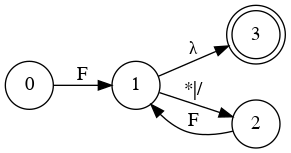
E
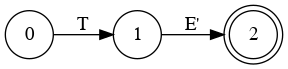
E'
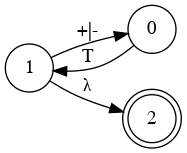
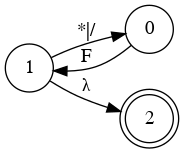
Simplify Diagram(VI) - Combining T and T'
T
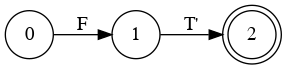
T'
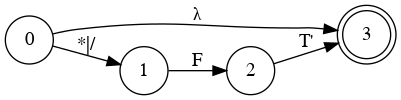
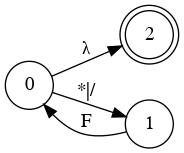
Parser Code for Last Calculator
E
T
F
1 def S(lex1):
2   lex1.getToken()
3   if E(lex1) == True:
4     if lex1.ct.type == 'EOF':  print(True)
5     else:
6       print('Syntax Error: extra characters at END: ')
7       print(lex1.s[lex1.begin:])
8   else: print('Syntax Error at', lex1.s[lex1.begin:])
9 def E(lex1):
10   while True:
11     if T(lex1) == False: return False
12     if lex1.ct.type not in ['+', '-']: break
13     lex1.getToken()
14   return True
15 def T(lex1):
16   while True:
17     if F(lex1) == False: return False
18     if lex1.ct.type not in ['*', '/']: break
19     lex1.getToken()
20   return True;
21 def F(lex1):
22   if lex1.ct.type == 'a':
23     lex1.getToken()
24   elif lex1.ct.type == '(':
25     lex1.getToken()
26     if E(lex1) == False: return False
27     if lex1.ct.type != ')' : return False
28     lex1.getToken()
29   else: return False
30   return True
Output Parser Tree
 9 def E(lex1):
10   while True:
11     print('E: ', lex1.s[lex1.begin:])
12     if T(lex1) == False: return False
13     if lex1.ct.type not in ['+', '-']:
14       break
15     print('+-: ', lex1.s[lex1.begin:])
16     lex1.getToken()
17   return True
18 def T(lex1):
19   while True:
20     print('T: ', lex1.s[lex1.begin:])
21     if F(lex1) == False: return False
22     if lex1.ct.type not in ['*', '/']:
23       break
24     print('*/: ', lex1.s[lex1.begin:])
25     lex1.getToken()
26   return True;
27 def F(lex1):
28   print('F: ', lex1.s[lex1.begin:])
29   if lex1.ct.type == 'a':
30     print('Number: ', lex1.ct.value)
31     lex1.getToken()
32   elif lex1.ct.type == '(':
33     lex1.getToken()
34     if E(lex1) == False: return False
35     if lex1.ct.type != ')' :
36       return False
37     lex1.getToken()
38   else: return False
39   return True
 1   rd$python3 e_t_f_plus_minus_mul_divide_parser_tree.py
 2   Enter an expression like 1+4*(3-1)
 3   > 1+4*(3-1)
 4   E:  1+4*(3-1)
 5   T:  1+4*(3-1)
 6   F:  1+4*(3-1)
 7   Number:  1.0
 8   +-:  +4*(3-1)
 9   E:  4*(3-1)
10   T:  4*(3-1)
11   F:  4*(3-1)
12   Number:  4.0
13   */:  *(3-1)
14   T:  (3-1)
15   F:  (3-1)
16   E:  3-1)
17   T:  3-1)
18   F:  3-1)
19   Number:  3.0
20   +-:  -1)
21   E:  1)
22   T:  1)
23   F:  1)
24   Number:  1.0
25   True
26   Enter an expression like 1+4*(3-1)
27   >
Representations of Parse Tree
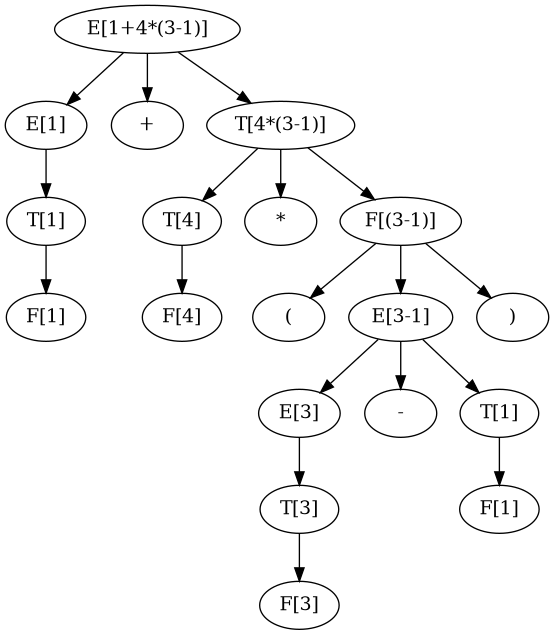
> 1+4*(3-1)
E:  1+4*(3-1)
T:  1+4*(3-1)
F:  1+4*(3-1)
Number:  1.0
+-:  +4*(3-1)
E:  4*(3-1)
T:  4*(3-1)
F:  4*(3-1)
Number:  4.0
*/:  *(3-1)
T:  (3-1)
F:  (3-1)
E:  3-1)
T:  3-1)
F:  3-1)
Number:  3.0
+-:  -1)
E:  1)
T:  1)
F:  1)
Number:  1.0
True
- E → E + T
- E → E - T
- E → T
- T → T
- T → T * F
- T → T / F
- T → F
- F → a
- F → (E)
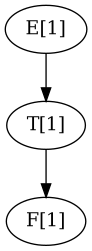
 > 1
E:  1
T:  1
F:  1
Number:  1.0
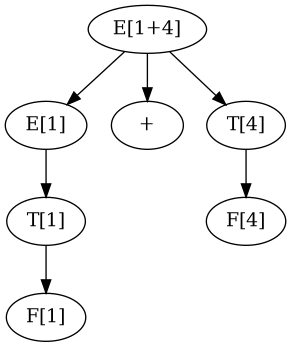
> 1
E:  1
T:  1
F:  1
Number:  1.0
+-:  +4*(3-1)
E:  4*(3-1)
T:  4*(3-1)
F:  4*(3-1)
Number:  4.0
- E → E + T
- E → E - T
- E → T
- T → T
- T → T * F
- T → T / F
- T → F
- F → a
- F → (E)
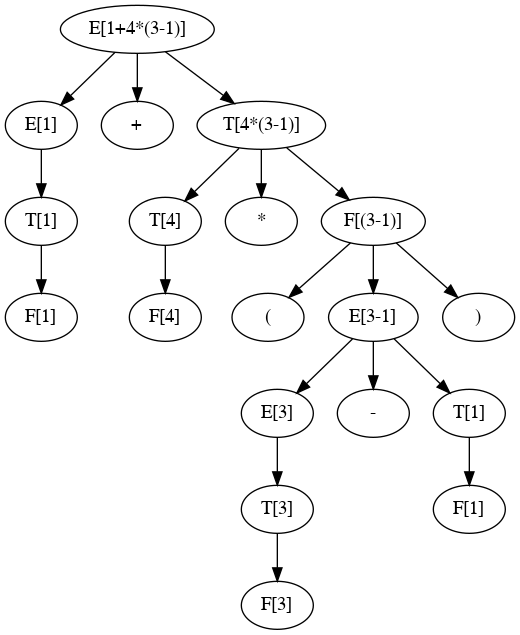
> 1+4*(3-1)
E:  1+4*(3-1)
T:  1+4*(3-1)
F:  1+4*(3-1)
Number:  1.0
+-:  +4*(3-1)
E:  4*(3-1)
T:  4*(3-1)
F:  4*(3-1)
Number:  4.0
*/:  *(3-1)
T:  (3-1)
F:  (3-1)
E:  3-1)
T:  3-1)
F:  3-1)
Number:  3.0
+-:  -1)
E:  1)
T:  1)
F:  1)
Number:  1.0
True
- E → E + T
- T[1] + T
- F[1] + T
- a[1] + T
- a[1] + T * F
- a[1] + F * F
- a[1] + a[4] * F
- a[1] + a[4] * (E)
- a[1] + a[4] * (E-T)
- a[1] + a[4] * (T-T)
- a[1] + a[4] * (F-T)
- a[1] + a[4] * (a[3]-T)
- a[1] + a[4] * (a[3]-F)
- a[1] + a[4] * (a[3]-a[1])
Calculator
2 def E(s1):
3   [s1, x]=T(s1)
4   while len(s1) > 0 and \
5       (s1[0] == '+' or s1[0] == '-'):
6     if s1[0]=='+':
7       flag = True
8     else:
9       flag = False;
10     [s1, y] = T(s1[1:])
11     if flag == True:
12       x += y;
13     else:
14       x -= y
15   return [s1, x]
16
17 def T(s1):
18   [s1, x] = F(s1)
19   while len(s1) > 0 and \
20       (s1[0] == '*' or s1[0] == '/'):
21     if s1[0] == '*':
22       flag = True;
23     else:
24       flag = False;
25     [s1, y] = F(s1[1:])
26     if flag == True:
27       x *= y;
28     else:
29       x /= y
30   return [s1, x]
31 def F(s1):
32   if s1[0] == '(':
33     s1 = s1[1:]
34     [s1, x] = E(s1)
35     if len(s1) == 0 or s1[0] != ')':
36       print('Error: ) missing')
37       raise
38     s1 = s1[1:]
39     return [s1, x]
40   else:
41     a = re.match('[0-9]+(\\.[0-9]+)?', s1)
42     s1 = s1[a.end():]
43     return [s1, float(a.group())]
44
45 st = input('Enter >> ') #st='12+35-2'
46 while st != "":
47   try:
48     [s1, val] = E(st)
49     print(val)
50   except:
51     print('Error')
52   st = input('Enter >> ') #st='12+35-2'
Calculator(IV)
1 import re, traceback as tb
2 class Lexical:
3
4   def getToken(self):
5     i=self.index
6     res = ['$', i];
7     if len(self.s) <= i:
8       return res
9     self.pi = self.index
10     c=self.s[self.index]
11     if   c == '*': res[0]='*'
12     elif c == '/': res[0]='/'
13     elif c == '+': res[0]='+'
14     elif c == '-': res[0]='-'
15     elif c == '(': res[0]='('
16     elif c == ')': res[0]=')'
17     elif '0' <= c <= '9':
18       p=r'[0-9]+(\.[0-9]+)?'
19       a=re.match(p,self.s[i:])
20       x = float(a.group())
21       res=['n', x]
22       self.index += a.end()-1
23     else:
24       raise Exception('UN:'+c)
25     self.index += 1
26     self.ct = res
27     return res
28
29   def __init__(self, s = '4'):
30     self.ct=['$', 0]; self.s=s
31     self.index=0; self.pi = 0
32
33   def unget(self):
34     self.index = self.pi
35
36 def F(lex):
37   x = 0
38   if lex.ct[0] == 'n':
39     x = lex.ct[1];
40   elif lex.ct[0] == '(':
41     lex.getToken()
42     x = E(lex);
43     print(lex.ct)
44     if lex.ct[0] != ')':
45       raise Exception(')')
46   else:
47     raise Exception('F()', lex.ct[0])
48   lex.getToken()
49   return x;
50
51 def T(lex):
52   x = F(lex);
53   p = lex.ct[0]
54   while p in ['*', '/']:
55     lex.getToken()
56     y = F(lex);
57     if p == '*': x *= y
58     else:        x /= y;
59     p = lex.ct[0]
61   return x;
62
63 def E(lex):
64   x = T(lex);
65   p = lex.ct[0]
66   while p in ['+', '-']:
67     lex.getToken()
68     y = T(lex);
69     if p == '+': x += y
70     else: x -= y;
71     p = lex.ct[0]
72   return x;
73
74 def getInput():
75   s = input('Enter>> ')
76   return s.strip()
77
78 s = getInput()
79 while s != '':
80   try:
81     lex = Lexical(s)
82     lex.getToken();
83     print(E(lex));
84   except Exception as e:
85     d=tb.format_exception(e)
86     print("".join(d))
87   s=getInput()
Lexial of Calc80 in Python
1 import re, traceback as tb
2
3 class RegexMatch:
4
5   def __init__(self, pattern):
6     self.pattern = re.compile(pattern)
7     self.match = None
8
9   def __eq__(self, other):
10     self.match = self.pattern.match(str(other))
11     return self.match is not None
12
13 class Patterns:
14     NUM = RegexMatch(r"[0-9]")
15
16 class yo_error(BaseException):
17   def __init__(self,s, s2=''):self.s=s+str(s2)
18
19 class Lexical:
20   def __init__(self, s = '4'):
21     self.reset(s)
22
23   def reset(self, s):
24     self.ct = ['$', 0]; self.s = s
25     self.index = 0; self.pi = 0
26
27   def __str__(self):
28       return f'i:{self.index}, '+\
29         f'ct:{self.ct}, s:{self.s}'
30   def getToken(self):
31     res = ['$', 0]
32     while self.index < len(self.s) \
33         and s[self.index] in [' ', '\t']:
34       self.index +=1
35     if len(self.s) <= self.index:
36       return res
37     self.pi = self.index;
38     match self.s[self.index]:
39       case '+': res[0] = '+'
40       case '-': res[0] = '-'
41       case '*': res[0] = '*'
42       case '/': res[0] = '/'
43       case '(': res[0] = '('
44       case ')': res[0] = ')'
45       case Patterns.NUM:
46         p = r'[0-9]+(\.[0-9]+)?'
47         a = re.match(p,
48           self.s[self.index:])
49         res = ['n', float(a.group())]
50         self.index += a.end() - 1;
51       case _:
52         raise yo_error('lexical:', self.s)
53     self.index += 1
54     self.ct = res
55     return res
Parser of Calc80 in Python
57 class Parser:
58   def __init__(self, lex):
59     self.lex = lex
60
61   def F(self):
62     x = 0
63     match self.lex.ct[0]:
64       case 'n': x=self.lex.ct[1]
65       case '(':
66         self.lex.getToken()
67         x = self.E();
68         if self.lex.ct[0] != ')':
69           raise yo_error('):: ',self.lex)
70       case _:
71         raise yo_error('F()',
72           self.lex)
73     self.lex.getToken()
74     return x;
75
76   def E(self):
77     x = self.T();
78     while self.lex.ct[0] in ['+', '-']:
79       p = self.lex.ct[0]
80       self.lex.getToken()
81       y = self.T();
82       if p == '+': x += y
84       else: x -= y;
85     return x;
86
87   def T(self):
88     x = self.F();
89     while self.lex.ct[0] in ['*', '/']:
90       p=self.lex.ct[0]
91       self.lex.getToken()
92       y = self.F();
93       if p == '*': x *= y
94       else:        x /= y;
95     return x;
96
97 def getInput():
98   s = input('Enter>> ')
99   return s.strip()
100
101 if __name__ == '__main__':
102   lex = Lexical()
103   parse=Parser(lex)
104   while True:
105     s = getInput(); lex.reset(s)
106     if len(s.strip()) == 0 :break
107     try:
108       lex.getToken();
109       print(parse.E());
110     except yo_error as yo:
111       print('yo_error ', yo.s);
112     except Exception as e:
113       dt=tb.format_exception(e)
114       print("".join(td))
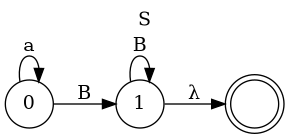
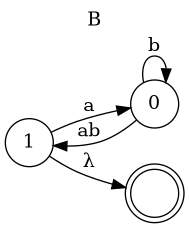
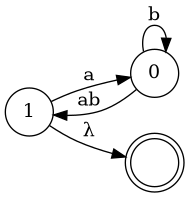
Another Grammar(I)
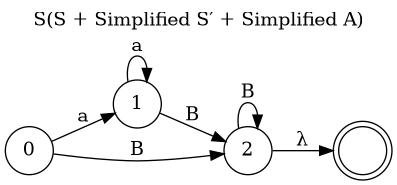
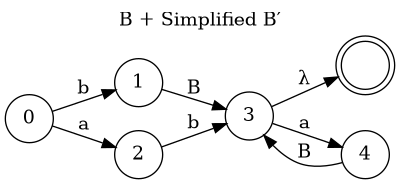
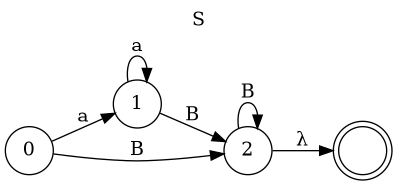
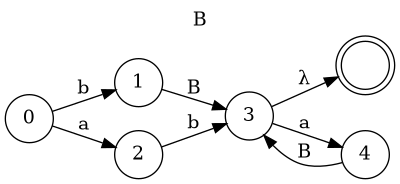
- S → AB | SB | B
- A → aA
- B → bB | BaB | ab
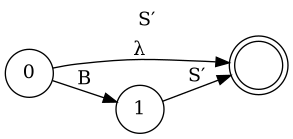
Eliminate Left Recursion
- S → AB | SB | B
- S → ABS′ ∣ BS′
- S′ → BS′ ∣ λ
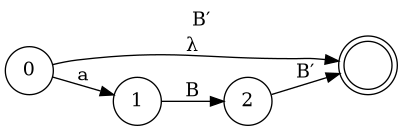
- B → bB | BaB | ab
- B → bBB′ ∣ abB′
- B′ → aBB′ ∣ λ
Another Grammar(II)
1 class Parser:
2   def __init__(self, text):
3     self.text = text; self.pos = 0
4   def cur_ch(self):
5     if self.pos < len(self.text):
6       return self.text[self.pos]
7     return None
8   def match(self, token):
9     if self.text.startswith(token, self.pos):
10       self.pos += len(token); return True
11     return False
12   def error(self, message):
13     raise SyntaxError(
14       f"{message} at position {self.pos}")
15   def S(self):
16     while self.match('a'):print("S: consume 'a'")
17     self.B()
18     while self.cur_ch() in ('a', 'b'):
19       old_pos = self.pos
20       try: self.B()
21       except SyntaxError: self.pos = old_pos; break
22   def B(self):
23     while self.match('b'): print("B: consume 'b'")
24     if self.match('ab'):print("B: consume 'ab'")
25     else:self.error("Expected 'ab'")
26     while self.match('a'):self.B()
27   def parse(self):
28     self.S()
29     if self.pos != len(self.text):
30       self.error("Unexpected input")
31     print("\nInput accepted.")
32
33 samples = ["ab","aab","bbab","abbab","aaabbab",]
34 for s in samples:
35   print("\n==========\nInput:", s)
36   try: parser = Parser(s); parser.parse()
37   except SyntaxError as e:print("Syntax Error:", e)
- S → AB | SB | B { S → ABS′ ∣ BS′, S′ → BS′ ∣ λ }
- B → bB | BaB | ab {B → bBB′ ∣ abB′, B′ → aBB′ ∣ λ }
- first(S) = {a} ∪ first(B)
- first(B) = {a, first(ab)} = {a, b}
- first(S) = {a, b}
Lexical C++
1 #include<iostream>
2 #include<cstdlib>
3
4 enum TokenType{
5   NUMBER, PLUS, MINUS, MUL, DIV,
6   LPAR, RPAR, END_OF_INPUT
7 };
8 struct Token
9 {TokenType type; int n; double r;};
10
11 void error(const std::string msg){
12   std::cout << msg << std::endl;
13   exit(0);
14 }
15
16 Token  t;
17 char buffer[200];
18 int tindex = 0;
19
20 void E(void);
21 void T(void);
22 void F(void);
23
24 void read(void){
25   std::cout << "Enter expression"
26     << std::endl;
27   std::cin>>buffer;
28 }
29
30 Token getToken(void){
31   static int number_of_call = 0;
31   number_of_call ++;
32   if(buffer[tindex] == '(')
33     t.type = LPAR;
34   else if(buffer[tindex] == ')')
35     t.type = RPAR;
36   else if(buffer[tindex] == '+')
37     t.type = PLUS;
38   else if(buffer[tindex] == '-')
39     t.type = MINUS;
40   else if(buffer[tindex] == '*')
41     t.type = MUL;
42   else if(buffer[tindex] == '/')
43     t.type = DIV;
44   else if(buffer[tindex] >= '0' &&
45       buffer[tindex]<='9'){
46     t.type=NUMBER;
47     t.n = 0;
48     for(; buffer[tindex] >= '0'
49         && buffer[tindex] <='9'; tindex++)
50       t.n = t.n * 10 + buffer[tindex] - 48;
51     tindex --;
52   }
53   else if(buffer[tindex] == '\0')
54     t.type = END_OF_INPUT;
55   else
56     error("unknown character");
57   //std::cout << t.type<<'\t'<<tindex<<'\t'
58   //<<number_of_call<<'\t'<<t.n<<std::endl;
59   tindex++;
60   return t;
61 }
Calculator C++
63 void A(void){
64   t = getToken();
65   E();
66   if(t.type != END_OF_INPUT)
67     error("unrecognized token");
68   else
69     std::cout << "Accept" << std::endl;
70 }
71
72 void E(void){
73   T();
74   while(t.type == PLUS || t.type == MINUS){
75     t = getToken();
76     T();
77   }
78 }
79
80 void T(void){
81   F();
82   while(t.type == MUL || t.type == DIV ){
83     t = getToken();
84     F();
85   }
86 }
87
88 void F(void){
89   if(t.type == LPAR){
90     t = getToken();
91     E();
92     if(t.type != RPAR)
93       error(" ) is missing");
94   }
95   else if(t.type==NUMBER)
96     ;
97   else
98     error("Wrong token ");
99   t = getToken();
100 }
101
102 void tryGetToken(void){
103   do{
104     t = getToken();
105   }while(t.type != END_OF_INPUT);}
106
107 int main(){
108   read(); /*tryGetToken();*/
109   A();
110   return 0;
111 }/*2-(3-2)/(3-(2-1)/(5-2*2))-1+2*/
Simple Programming Language
 1 BEGIN
 2     LET I = 12
 3     PRINT I
 4     LET I = I - (2-(3-2)/(3-(2-1)/(5-2*2))-1+2)
 5     PRINT I+ 2-(3-2)/(3-(2-1)/(5-2*2))-1+2
 6     LET I=19
 7     WHILE I-8
 8     BEGIN
 9        PRINT I
10        LET I=I-1
11     END
12     LET I=3
13     WHILE I
14     BEGIN
15        PRINT I
16        LET J=6
17        WHILE J
18        BEGIN
19          LET J=J-2
20          PRINT J
21        END
22        LET I=I-1
23     END
24 END
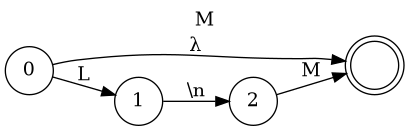
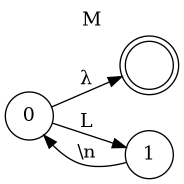
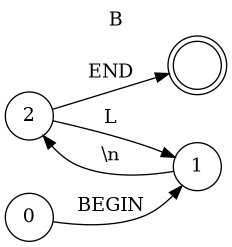
- A → B 'EOF'
- B → 'BEGIN' '\n' M 'END'
- M → L '\n' M | λ
- L → 'LET' 'ID' = E
- L → 'PRINT' E
- L → 'WHILE' E '\n' B
- E → T E'
- E' → + T E' | -T E' | λ
- T → F T'
- T' → * F T' | / F T' | λ
- F → 'NUMBER'
- F → 'ID'
- F → ( E )
src/rd/simple_language_1/cpp/simple_language_1.cpp
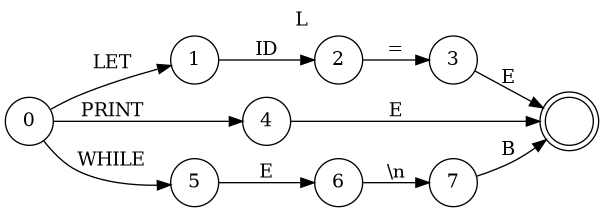
Chart for simple programming Languaguge
- A → B 'EOF'
- B → 'BEGIN' '\n' M 'END'
- M → L '\n' M | λ
- L → 'LET' 'ID' = E
- L → 'PRINT' E
- L → 'WHILE' E '\n' B
- E → T E'
- E' → + T E' | -T E' | λ
- T → F T'
- T' → * F T' | / F T' | λ
- F → 'NUMBER'
- F → 'ID'
- F → ( E )
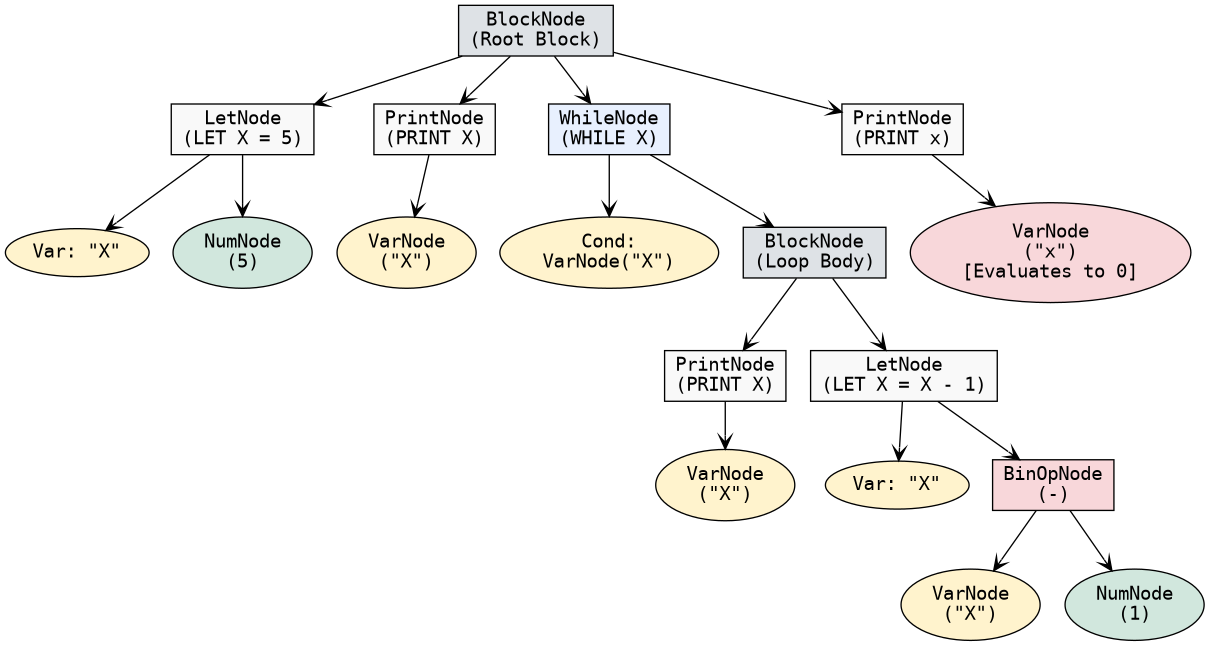
Creating Syntax Tree (Top Down)
BEGIN
  LET X = 5
  PRINT X
  WHILE X
  BEGIN
    PRINT X
    LET X = X - 1
  END
  PRINT x
END
1 from sly import Lexer
2 class BasicLexer(Lexer):
3   tokens = {
4     BEGIN,END,LET,PRINT,WHILE,ID,NUMBER,NEWLINE,
5   }
6   literals = {"+", "-", "*", "/", "=", "(", ")"}
7   ignore = " \t"
8   @_(r"[A-Za-z_][A-Za-z0-9_]*")
9   def ID(self, t):
10     v = {"BEGIN", "END", "LET", "PRINT", "WHILE"}
11     if t.value in v: t.type = t.value
12     return t
13   @_(r"\d+")
14   def NUMBER(self, t):
15     t.value = int(t.value); return t
16   @_(r"\n+")
17   def NEWLINE(self, t):
18     self.lineno += len(t.value); return t
19   def error(self, t): raise SyntaxError("Err")
20 class BlockNode:
21   def __init__(self, s): self.s = s
22   def eval(self, env):
23     for st in self.s: st.eval(env)
24 class LetNode:
25   def __init__(self, n, e): self.n, self.e = n, e
26   def eval(self, env): env[self.n] = self.e.eval(env)
27 class PrintNode:
28   def __init__(self, e): self.e = e
29   def eval(self, env): print(self.e.eval(env))
30 class WhileNode:
31   def __init__(self, c, b): self.c, self.b = c, b
31   def eval(self, env):
32     while self.c.eval(env) != 0: self.b.eval(env)
33 class BinOpNode:
34   def __init__(self, o, l, r):
35     self.o, self.l, self.r = o, l, r
36   def eval(self, env):
37     l, r = self.l.eval(env), self.r.eval(env)
38     if self.o == "+": return l + r
39     if self.o == "-": return l - r
40     if self.o == "*": return l * r
41     if self.o == "/": return l // r
42 class NumNode:
43   def __init__(self, v): self.v = v
44   def eval(self, env): return self.v
45 class VarNode:
46   def __init__(self, n): self.n = n
47   def eval(self, env): return env.get(self.n, 0)
48 class Interpreter:
49   def __init__(self, src):
50     self.tk = list(BasicLexer().tokenize(src))
51     self.p = 0; self.vars = {}
52   def cur(self):
53     if self.p < len(self.tk): return self.tk[self.p]
54     return None
55   def cur_t(self):
56     c = self.cur()
57     return c.type if c else "EOF"
58   def advance(self):
59     t = self.cur(); self.p += 1; return t
60   def match(self, k):
61     if self.cur_t() == k: return self.advance()
62     return None
63   def expect(self, k):
64     t = self.match(k)
65     if not t: raise SyntaxError("Err")
66     return t
67   def parse(self):
68     while self.cur_t() == "NEWLINE": self.advance()
69     ast = self.B() # Annotated Syntax Tree
70     while self.cur_t() == "NEWLINE": self.advance()
71     return ast
72   def B(self):
73     self.expect("BEGIN"); self.expect("NEWLINE")
74     st = self.M(); self.expect("END")
75     return BlockNode(st)
76   def M(self):
77     st = []; v = ("LET", "PRINT", "WHILE", "NEWLINE")
78     while self.cur_t() in v:
79       if self.cur_t() == "NEWLINE":
80         self.advance()
81         continue
82       st.append(self.L())
83       if self.cur_t() == "NEWLINE": self.advance()
84     return st
85   def L(self):
86     if self.match("LET"):
87       n = self.expect("ID").value
88       self.expect("=")
89       return LetNode(n, self.E())
90     if self.match("PRINT"):
91       return PrintNode(self.E())
92     if self.match("WHILE"):
93       c = self.E()
94       while self.cur_t() == "NEWLINE": self.advance()
96       return WhileNode(c, self.B())
97     raise SyntaxError("Err")
98   def E(self):
99     n = self.T()
100     while self.cur_t() in ("+", "-"):
101       o = self.advance().type
102       n = BinOpNode(o, n, self.T())
103     return n
104   def T(self):
105     n = self.F()
106     while self.cur_t() in ("*", "/"):
107       o = self.advance().type
108       n = BinOpNode(o, n, self.F())
109     return n
110   def F(self):
111     t = self.cur()
112     if not t: raise SyntaxError("Err")
113     if t.type == "NUMBER":
114       self.advance()
115       return NumNode(t.value)
116     if t.type == "ID":
117       self.advance()
118       return VarNode(t.value)
119     if t.type == "(":
120       self.advance(); n = self.E(); self.expect(")")
121       return n
122     raise SyntaxError("Err")
123 source = """BEGIN
124 LET X = 5
125 PRINT X
126
127 WHILE X
List of Related Files
- src/rd/simple_language_1/
- simple_language_1.py
- created by chatgpt.com
- simple_language20.py
- Edited by Grok AI and Gemeni AI
- simple_language30.py
- reformat by Gemini AI
- simple_language50.py
- Add argparse added by me
- sly folder of sly tool
- src/rd/simple_language_1/cpp/
- simple_language20.cpp
- Gemini Ai created (Flawed)
- simple_language30.cpp
- Gemini Ai reformated (Flawed)
- simple_language50.cpp
- Change by hand to support arguments (Flawed)
- simple_language_1.cpp
- My old code for interpreted
- Compiles and works fine after decades
- simple_language_2.cpp
- Reformated of my old code by hand
- I like to update it more but I will not able to.
End